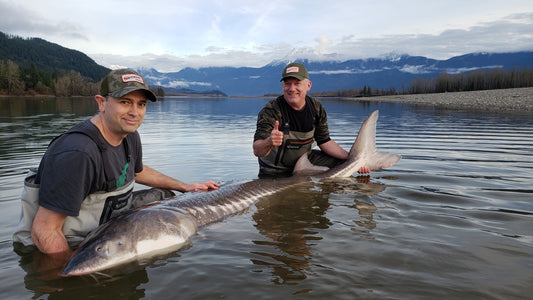
Want to make the most of your sturgeon trip? or level up your own approach to these incredible fish? Whether you’re joining us on the Fraser or fishing elsewhere, a few fundamentals make a huge difference.
Here are practical tips on gear, bait, and boat etiquette that will help you fish more effectively, fight fish more confidently, and respect the river and the people on it.
Gear: Use tackle that respects the fish
Sturgeon aren’t panfish, they’re incredibly powerful, long-lived fish. Using gear that’s too light prolongs the fight and increases stress on the fish.
A good sturgeon setup includes:
-
Heavy-duty rods with enough backbone to control big fish.
-
Quality reels with strong, smooth drags.
-
High-strength main line capable of handling heavy current and big runs.
-
Appropriate leaders and hooks designed for strong takes and safe releases.
On our guided trips, we supply all of this for you. If you’re fishing independently, prioritise durability and control over “sportiness.”
Bait: Think like a sturgeon
Sturgeon are opportunistic bottom feeders. They’ll eat a variety of natural baits depending on what’s abundant in the system, including:
-
Pieces of fish
-
Roe and other natural offerings
-
Locally relevant food sources
Key points:
-
Freshness matters: Well-presented, properly stored bait consistently outfishes old or poorly prepared bait.
-
Scent trails matter: Position your baits where the current will carry scent into likely travel lanes.
-
Experiment within reason: On tough days, changing bait type, size, or presentation can make a difference.
When you fish with us, we bring a selection of proven baits for the conditions, and we rotate them as the day unfolds.
Fighting technique: Work smart, not just hard
Hooking a big sturgeon is only half the battle. Fighting it efficiently is better for you and better for the fish.
A few key tips:
-
Use your legs and core:
Don’t try to muscle the fish with your arms alone. Keep your feet planted, bend your knees, and lean back to apply pressure. -
Keep steady pressure:
Short pumps and controlled reeling beat wild, jerky movements. -
Listen to your guide:
We’ll coach you through drag adjustments, rod angles, and when to push vs when to let the fish run. -
Tag-team if needed:
It’s completely fine to swap out mid-fight. A clean, efficient battle is better than pushing yourself past your limit.
Boat etiquette: How to be a great guest
Boat etiquette is simple: respect the crew, respect each other, respect the river.
On a guided sturgeon trip, that looks like:
-
Communication:
Tell us about any injuries, motion sickness, or concerns early. -
Safety first:
Follow instructions around moving in the boat, wearing PFDs, and what to do in certain situations (anchor procedures, big fish near the boat, etc.). -
Rod awareness:
Don’t leave rods unattended in ways that can lead to accidents. Listen for cues about which rod to grab and when. -
Respect for other anglers:
Celebrate each other’s fish. Sturgeon trips are very much a team effort.
Fish handling: The non-negotiables
Whether you’re with a guide or not, good handling is essential:
-
Keep big fish in the water or in very shallow water whenever possible.
-
Never lift a large sturgeon by the gills or tail alone.
-
Minimise time out of position for photos — plan shots in advance.
-
Always support the fish’s body, not just one end.
-
Revive fish properly, facing them into the current until they kick away strongly.
The goal is simple: unforgettable experiences, with minimal impact on these incredible animals.