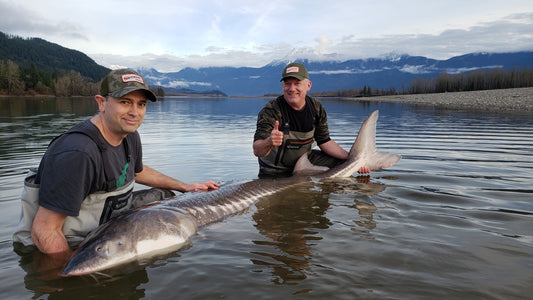
On the Fraser River, hooking into a true giant sturgeon is only half the battle – the other half is what you do next. Many anglers’ instinct is to stay put and fight the fish from an anchored boat, but Yves Bisson says pull the anchor if you want to land it quicker. “If you hook a big one and stay anchored, it can take much more time to land your fish. It’s counterintuitive to novices, but in the heavy current of the Fraser, a 500-pound sturgeon at the end of your line combined with the river’s force is an almost unbeatable adversary if you remain tethered to one spot. The strain can be so extreme that even 200-pound test line can snap like sewing thread, and rods can literally crack under the pressure.
Bisson’s approach could be called “mobile warfare.” The moment it’s clear a hooked fish is a heavyweight (often evident by an earth-shaking pull or an 8-foot leviathan leaping out of the water), the anchor chain is pulled up without hesitation. His boat is equipped with a windless anchor which can be pulled up in seconds. This allows Bisson to fire up the engine and follow the fish downstream. By pursuing the sturgeon, the team keeps the fight directly above the fish, maintaining a near-vertical line working the fish more efficiently and saving time.
Why is this so important? Think of the difference between pulling straight up versus dragging at an angle. When you’re anchored and a huge sturgeon runs downstream, your fishing line slices through the water at a low angle, creating massive drag. The fish can also use the riverbed to its advantage, potentially wrapping the line around sunken logs, boulders, or other debris. Many legendary fish have been lost because they found a snag while the angler was stuck fighting from one spot. By contrast, when you follow the fish with the boat, you stay almost above it. The line is vertical or at least much steeper, which drastically reduces water resistance and prevents the fish from gaining leverage or hiding behind structure.
The benefits of a mobile fight are dramatic. A battle that might have taken much more time on anchor where it can often be resolved in twenty or thirty minutes when the boat is chasing the sturgeon. Bisson recounts how first-time sturgeon anglers are often shocked by this tactical dance on the river. One moment, everyone is calm, anchored and waiting for a bite; the next, a reel is screaming and Bisson is barking cheerful orders to “get that anchor up, now!” The boat accelerates downriver, matching every powerful run of the fish. It’s an adrenaline-filled chase, but it tilts the odds back in the angler’s favor.
This strategy isn’t just about saving gear or an angler’s energy – it’s also about fish welfare. By shortening the fight, the sturgeon still has plenty of energy left at release. “It’s safer for the angler, and more importantly, it’s safer for the fish,” Bisson says. A sturgeon that isn’t pushed to total exhaustion will swim away stronger, increasing its chances of surviving, spawning, and maybe even giving another angler the thrill of a lifetime down the road.
Indeed, mobility is a game-changer in trophy sturgeon fishing. Guides on the Fraser have learned this through experience, and Bisson has been a leading advocate of the technique. He often shares this advice with fellow anglers who might be used to anchoring for other species: don’t be a sitting duck. Once that prehistoric giant is hooked, pull the anchor, hold on, and give chase. In this form of river combat, the best defense is a good offense – staying on the move keeps you in control of the fight and greatly improves your odds of bringing a true river monster alongside for a safe release.