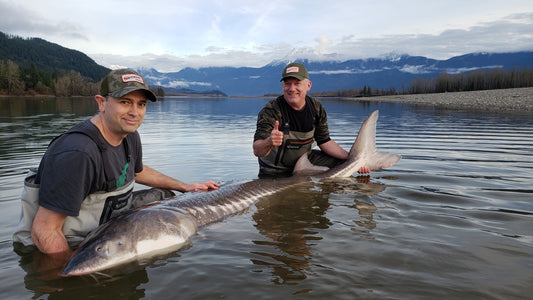
When people imagine a monster sturgeon bite, they often picture a rod nearly ripped out of the holder and a reel screaming in agony. The reality, as Yves Bisson often points out, is surprisingly different. In fact, some of the largest sturgeon in the river often have the most delicate bite of all. “I’ve seen 600-pound fish bite like a tiny minnow,” Bisson says, describing how gentle giants can fool even experienced anglers.
Rod-tip action is everything when looking for a bite or even determining whether or not it actually is a bite. Just because the rod tip moves does not mean it is a bite, in fact most of the time it’s not and that is why Bisson’s experience is vital when on your charter. Sturgeon can casually inhale a bait off the river bottom without the rod tip even moving, yes thats correct… For such a big fish it seems impossible to imagine this but understanding that you are in a massive river with extreme flows or sometimes no flow at all can lead to many different types of bites. Each time the baits go down depending on depth, water flow, and how heavy the weight is each bite can look dramatically different. It can be a sharp tug or a violent yank, or simply a tiny move of 1-2 inches. It might look as if your weight (sinker) has snagged a clump of weeds or is dragging in the current – a slow, steady, heavy bend. It’s not dramatic at first glance. Less experienced fishermen might think nothing is happening at all, mistaking the movement for a bit of debris on the line. But in Bisson’s boat, that subtle dip is cause for immediate alert. “If you see the rod just leaning over gradually, almost like you’ve caught a piece of driftwood in the current – get ready,” he advises. “That’s a big fish vacuuming up the bait off the bottom. They don’t strike like many other fish.
Understanding sturgeon feeding behavior explains why the bite looks like this. White sturgeon are suction feeders; they extend tube-like mouths to hoover up food from the riverbed. A large adult might approach a bait (say, a salmon chunk or a glob of roe) cautiously. Rather than darting or hitting it hard, the fish hovers and then gulps a large volume of water, pulling the food in like a vacuum. The angler’s rod responds to this with that trademark bend as the fish’s weight gradually loads the line. Often, truly big sturgeon will mouth the bait, move a short distance, and even pause, which creates that slow rod-tip bend.
The key for anglers is patience and timing. It takes nerves of steel not to immediately jerk the rod at the first hint of movement which often scares away the fish and your chance at getting it. Bisson coaches his clients to watch and wait for the correct time to strike. If the rod tip is just twitching or bouncing erratically, it’s likely a small baitfish, fish swimming through the line, or the weight moving. The sturgeon may mouth the bait for several seconds. Only when the rod stays loaded—when you can truly feel the weight of a moving giant on the end—does Bisson say to set the hook, and when he does, it’s with everything you’ve got. “You have to drive that hook home, hard,” he emphasizes, because a big sturgeon’s mouth is like rubbery sandpaper and often hard to penetrate.
Too early, and you’ll yank the bait away from a sturgeon that hasn’t fully taken it in. Too late, and the fish might realize something’s amiss and spit the bait out. The art of the bite is in recognizing that sweet spot – that moment when curiosity turns into commitment on the sturgeon’s part. Bisson’s experience on the Fraser has taught him to almost read the sturgeon’s mind through the rod tip. It’s a skill honed over a few hundred thousand bites.