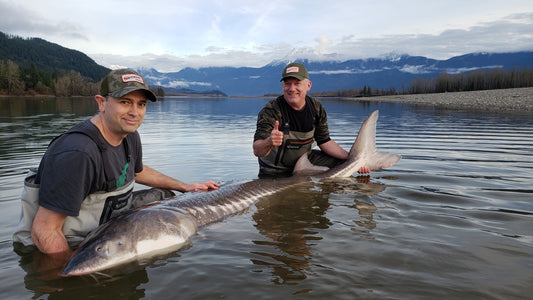
When veteran Fraser River fishing guide Yves Bisson waves a scanner over a giant white sturgeon and hears nothing but silence, he knows there's a chance it might be a fish never caught before. In sturgeon research, silence from the PIT tag scanner means the fish is untagged and has never been caught or documented before. Bisson recalls one recent catch: “When the scanner stays silent, that’s when the real story begins,” he says, describing the adrenaline rush of discovering a truly wild sturgeon.
A 10.5-foot, ~600-pound “untagged sturgeon” that Bisson landed not long ago proved just how special these catches are. Based on its size and girth, he estimated the fish to be at least 80-100 years old – meaning it was likely swimming the Fraser River during World War II and through decades of environmental change without ever encountering a hook. “We were just able to tag it, so it probably has never been caught. Unreal!” Bisson shared in a video as he carefully guided the massive creature in the shallows. For a guide who has landed over 28,000 sturgeon in his career, this catch stood out as, in Bisson’s own words, “one of the largest untagged sturgeon I’ve ever seen.”
Finding these hidden giants is the ultimate reward for both angler and conservationist. The Fraser River has had an active sturgeon conservation program since 1997, and over 80,000 sturgeon have been tagged as part of efforts to monitor the population. Most large sturgeon encountered today carry a tiny microchip (PIT tag) implanted near their head – a digital passport that logs their size, age, and past captures when looked up in the database. So when a trophy-sized fish shows up with no tag, it’s a big deal. It means this fish has evaded scientists and fishermen for a century, living completely under the radar. Each new “untagged giant” confirms that there are still untouched leviathans lurking in the depths, a sign that the population is not only surviving but that some old-timers are thriving in the shadows.
For Bisson, the mission isn’t just about the thrill of the catch; it’s about gathering data for conservation. Every untagged sturgeon is quickly scanned, tagged, measured, and released, contributing a vital piece to the puzzle of the species’ longevity and range. These giants carry priceless information in their DNA and life history. “Every ‘new sturgeon’ we tag is a new chapter in the survival story of the white sturgeon,” Bisson explains, emphasizing the importance of research. By tagging a previously unknown fish, scientists can start tracking its movements and growth, helping to inform how to best protect these living dinosaurs.
Untagged behemoths like the one Bisson caught also validate the success of conservation measures. Decades ago, white sturgeon faced intense overfishing and were nearly wiped out in the Fraser. Today, strict catch-and-release rules and tagging programs have helped the species rebound. The fact that an enormous, elderly sturgeon can still be out there, untouched, suggests that the river’s ecosystem can support these long-lived giants. It’s a hopeful reminder that with the right protection, nature finds a way to persevere.
In an era where virtually every big sturgeon in the Fraser has a record, the true “untagged giants” are the holy grail. They are a testament to the river’s hidden richness and the resilience of a species that has outlived the dinosaurs. When Yves Bisson talks about that silent scanner moment, it’s with reverence. It’s not just about a trophy fish – it’s about touching a piece of the past. And with each new encounter that surfaces, he and his team gain new resolve to protect the Fraser River’s giant sturgeon for future generations.